Thursday, March 20, 2008

Homelessness and Being Like jesus

When I grow up I want to be like my friend Jon Reid, because he is like Jesus -- specifically the way he loves the people most of us wouldn't even want to get close to. In his blog he recently posted two articles about his interactions with homeless people. Homeless Adventure #1 and Homeless Adventure #2.

~ Keith

Spring Brings Life

Yesterday was the vernal equinox.

Now it is Spring.

The world around us is alive with color and sound as buds open and small birds move in for the season. Amidst this activity it is easy to get caught up in the busyness of the world around us, and bow to the tyranny of the urgent.

This morning I was reminded of a better way:
The world gives itself
up to incessant activity
merely because
it knows of nothing
better.
The inspired man
works among
its whirring wheels
also; but he knows
whither the wheels
are going,
for he has found
the centre
where all is
stillness...

~ Paul Brunton
~ Keith

Saturday, March 01, 2008

So I Stay Near the Door

I stay near the door.
I neither go too far in, nor stay too far out,
The door is the most important door in the world—
It is the door through which men walk when they find God.
There’s no use my going way inside, and staying there,
When so many are still outside, and they, as much as I,
Crave to know where the door is.
And all that so many ever find
Is only the wall where a door ought to be.
They creep along the wall like blind men.
With outstretched, groping hands,
Feeling for a door, knowing there must be a door,
Yet they never find it . . .
So I stay near the door.

The most tremendous thing in the world
Is for men to find that door—the door to God.
The most important thing any man can do
Is to take hold of one of those blind, groping hands,
And put it on the latch—the latch that only clicks
And opens to the man’s own touch.
Men die outside that door, as starving beggars die
On cold nights in cruel cities in the dead of winter—
Die for want of what is within their grasp.
They live, on the other side of it—
live because they have found it.
Nothing else matters compared to helping them find it,
And open it, and walk in, and find Him . . .
So I stay near the door.

Go in, great saints, go all the way in—
Go way down into the cavernous cellars,
And way up into the spacious attics—
In a vast, roomy house, this house where God is.
Go into the deepest of hidden casements,
Of withdrawal, of silence, of sainthood.
Some must inhabit those inner rooms,
And know the depths and heights of God,
And call outside to the rest of us how wonderful it is.
Sometimes I take a deeper look in,
Sometimes venture a little farther;
But my place seems closer to the opening . . .
So I stay near the door.

The people too far in do not see how near these are
To leaving—preoccupied with the wonder of it all.
Somebody must watch for those who have entered the door,
But would like to run away. So for them, too,
I stay near the door.

I admire the people who go way in.
But I wish they would not forget how it was
Before they got in. Then they would be able to help
The people who have not even found the door,
Or the people who want to run away again from God.
You can go in too deeply, and stay in too long,
And forget the people outside the door.
As for me, I shall take my old accustomed place,
Near enough to God to hear Him, and know He is there,
But not so far from men as not to hear them,
And remember they are there too.
Where? Outside the door—
Thousands of them, millions of them.
But—more important for me—
One of them, two of them, ten of them,
Whose hands I am intended to put on the latch,
So I shall stay by the door and wait
For those who seek it.
‘I had rather be a door-keeper . . .’
So I stay near the door.

~ Samuel Moor Shoemaker


~ Keith

Friday, February 08, 2008

Why I Might Say I'm Not A Christian

There are people living on the island of Mindanao in The Philippines who are followers of Jesus, and they hold worship services in a mosque. They don't call themselves Christians. They instead call themselves "Muslim followers of Issah" because if they identified themselves with the term "Christian" they would be persecuted or killed. They are not afraid of this: they are not ashamed of Christ; they are ashamed of His followers who have ruined His reputation.

In America there are people who follow Jesus, but they don't call themselves Christians. They are also ashamed of those who ruin Christ's reputation and so they instead call themselves "Followers of Christ" because if they identified themselves with the term "Christian", they might not be persecuted or killed, it could be worse -- they might get ignored.

Jesus' followers are called to (among other things) act as change-agents, offering a new life and hope to those who are trapped and weary. Problem is, in American culture the word "Christian" has become loaded with so many negative stereotypes. Its literal meaning is "Christ-like" or "Little Christ" but so many people have come to see "Christian" as synonymous with (at best) namby-pamby, goodie-two-shoes, irrelevant prudes or (at worst) hate-filled holier-than-thou hypocrites.

I heard an old song this morning that re-captivated my heart for what it means to follow Jesus:
Multiply Your Love
by Andy Park

Multiply Your love through us
To the lost and the least
Let us be Your healing hands
Your instruments of peace

May our single purpose be
To imitate Your life
Through our simple words and deeds
Let love be multiplied

Multiply Your love through me
To someone in need
Help me Lord to freely give
This grace that I've received

Let my single purpose be
To imitate Your life
Through my simple words and deeds
Let love be multiplied

Let us see Your kingdom come
To the poor and broken ones
Let us see a mighty flood
Of justice and mercy, O Jesus
Let love be multiplied

Multiply Your church through us
To the ends of the Earth
Where there's only barrenness
Let us see new birth

Use us as Your laborers
Working side by side
Let us see Your harvest come
Let love be multiplied
Then this afternoon I stumbled across some videos. The first 6 are parodies of the Mac vs PC commercials. As a person who uses both Macs and PCs but prefers Macs, I have to confess I see myself in both halves of these commercials -- and sadly I see myself in both halves of the below videos as well. The last video is not a parody of the commercial. It is somewhat similar, but more hard-hitting and direct, like quickly tearing off a band-aid (or getting sucker punched in the gut).

They are all funny because they hit so close to home. They are also poignant for the same reason. (ye be forewarned)


~ Keith

Thursday, January 17, 2008

Letter from Birmingham Jail

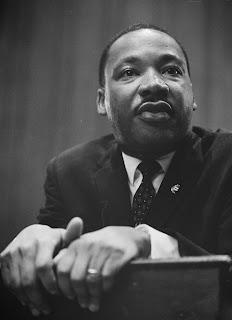
A friend recently eMailed me a portion of Dr. King's Letter from Birmingham Jail. In preparation for Monday's celebration of Dr. King's life and work, reading this letter has made me more aware of the world and how best to live.

On April 3, 1963 Martin Luther King called for all lunch counters, restrooms, and drinking fountains in Birmingham to be desegregated. Some called the city the most segregated city in the country. Its bombings and torchings of black churches and homes had given it the name “Bombingham.” That day sixty-five African Americans staged sit-ins in five stores, and the Police Commissioner dragged twenty of them away to jail.

On April 13, 1963, Good Friday, King and his team refused to follow a court injunction that forbade peaceful marching. King met the barricades and knelt beside his friend Ralph Abernathy, and was taken to the Birmingham City Jail. This was the 13th time King was arrested.

He was put in solitary confinement without mattress, pillow, or blanket. His situation improved when Attorney General Robert Kennedy asked why he was in solitary confinement. On Tuesday, April 16 he was brought a published letter signed by eight white clergymen of Alabama, criticizing King and the peaceful movement of demonstrations. King felt inspired to write a response.

What came from his pen is today called Letter from Birmingham Jail. It has been called “the most eloquent and learned expression of the goals and philosophy of the nonviolent movement ever written.” (Let the Trumpet Sound, Stephen B. Oates, 1994.)

The white clergy had all said: Be more patient. Wait. Don’t demonstrate. He wrote in response:
Perhaps it is easy for those who have never felt the stinging darts of segregation to say, “Wait.” But when you have seen vicious mobs lynch your mothers and fathers at will and drown your sisters and brothers at whim; when you have seen hate-filled policeman curse, kick, and even kill your black brothers and sisters; when you see the vast majority of your 20 million Negro brothers smothering in an airtight cage of poverty in the midst of an affluent society; when you suddenly find your tongue twisted and your speech stammering as you seek to explain to your six-year-old daughter why she cannot go to the public amusement park that has just been advertised on television, and see tears welling up in her eyes when she’s told that Funtown is closed to colored children, and see ominous clouds of inferiority beginning to form in her little mental sky, and see her beginning to distort her personality by developing an unconscious bitterness toward white people; when you have to concoct an answer for a five-year-old son who is asking, “Daddy, why do white people treat colored people so mean?”; when you take a cross-country drive and find it necessary to sleep night after night in the uncomfortable corners of your automobile because no motel will accept you; when you are humiliated day in and day out by nagging signs reading “white” and “colored”; when your first name becomes “Nigger,” your middle name becomes “boy” (however old you are) and your last name becomes “John,” and your wife and mother are never given the respected title “Mrs.”; when you are harried by day and haunted by night by the fact that you are a Negro, living constantly at tiptoe stance, never quite knowing what to expect next, and are plagued with inner fears and outer resentments; when you are for ever fighting a degenerating sense of “nobodiness” -- then you will understand why we find it difficult to wait. There comes a time when the cup of endurance runs over, and men are no longer willing to be plunged into the abyss of despair. I hope sirs, you can understand our legitimate and unavoidable impatience.
Finally he delivered a powerful call to the church which rings as true today as it did 40 years ago:
There was a time when the church was very powerful—in the time when the early Christians rejoiced at being deemed worthy to suffer for what they believed. In those days the church was not merely a thermometer that recorded the ideas and principles of popular opinion; it was a thermostat that transformed the mores of society. . . . But the judgment of God is upon the church [today] as never before. If today’s church does not recapture the sacrificial spirit of the early church, it will lose its authenticity, forfeit the loyalty of millions, and be dismissed as an irrelevant social club with no meaning for the 20th century.
You can download the whole letter as a pdf from Stanford here or read more online here.

~ Keith

Sunday, January 13, 2008

Chased by Promises

Eighteen hours ago I was driving home from a Vineyard Pastor's Retreat. It was raining really hard, but up ahead there was a break in the clouds. So I was driving in pouring rain, but looking at blue skies. In my rearview mirror I noticed something cool - a rainbow was there. Right. THERE! Like, the picture above, only all I could see was rainbow out my back window. And it was travelling with me -- chasing me. I don't know how long it was there before I noticed it.

The bible says the rainbow is a promise that God won't wipe us out in another flood (which was comforting, considering the amount of rain I was driving in!).

At the retreat, God really met me and reminded me of some promises He's made to me over the years -- promises I think I'd largely forgotten but, like the rainbow, they've been chasing me down all along.

As I type this I've had only 1 hour of sleep. I was on-call from midnight to 8 am and was out caring for families whose loved ones were dying. I saw three patients: one who did not die, one who died while I was there in their home with them and their family, and one who died before I arrived. I think that completeness of possibilities is poetic somehow.

On very little sleep, and on foggy roads, I was kept safe -- I was not wiped out by a flood or anything else. And now I'm going to sleep.

As I head to dreamland, the sun is out. I can't see the rainbow anymore but I will rest well, knowing I am still
chased by promises
~ Keith

Saturday, December 29, 2007

Jesus' Campaign Promises

In my favourite newsreader, I have a search set up for the word "Jesus" -- just to see what the media is saying. Lately there have been a lot of stories about nativity scenes being vandalized. This morning, though, I came across an article from the Athens Banner-Herald called Playing the Jesus Card can cut many ways. It was written by William McKenzie, an editorial columnist for The Dallas Morning News.

Mr. McKenzie makes some provocative statements and the article is well-worth the read. Here's an excerpt:
We voters better watch out when candidates play the Jesus Card. The child born in a manger turned out to be a radical figure. And his message can take us in demanding, unpredictable directions.

For example, there's that hard command to love your enemies. How would the professing candidates abide by that charge? Shouldn't we ask whether that dictum will affect how they deal with the opposition party on Capitol Hill? With Iran? And if it will affect them, how so?

Then there's the fact that Jesus spent much of his ministry challenging his day's religious establishment. Wow, that could create mighty big sparks if any of these candidates really played the Jesus Card.
Mr. McKenzie's final thoughts say it all:
Let's not boil Jesus down to the candidate of the left, right or middle. Let's remember that the child born in a manger was too complicated for that.
~ Keith